Author: Syeda Maleeha

  • Dubai Shopping Festival Marketing Ideas for Small Businesses (2026-27)

    Dubai Shopping Festival Marketing Ideas for Small Businesses (2026-27)

    The Dubai Shopping Festival is one of the biggest retail events in the region. The 32nd edition runs for 45 days, from 4 December 2026 to 17 January 2027, organised by Dubai Festivals and Retail Establishment (TradeArabia). Millions of residents and tourists shop, eat out and attend events across the city.

    You do not need to be an official partner to benefit. Shops, restaurants, salons, online stores and service businesses across the UAE can all plan offers and marketing around the festival. Here are practical Dubai Shopping Festival marketing ideas, plus what to prepare so your offers are actually found.

    Why DSF matters for small businesses

    • Shoppers expect deals, so they are actively looking for offers.
    • Tourists and visitors search for places to eat, shop and visit.
    • Mall and city events bring foot traffic to many areas of Dubai.
    • The season overlaps with year-end holidays and new-year spending.

    Dubai Shopping Festival marketing ideas

    • Festival offers: a clear DSF discount, bundle or gift with purchase for the 45 days.
    • Limited-time flash deals: weekend or 24-hour offers to create urgency.
    • Raffle or loyalty tie-ins: entries or points for purchases during the festival.
    • Tourist-friendly offers: for restaurants, salons, spas and experiences.
    • Gift guides: curated product lists for the new year and holidays.
    • Online-only DSF deals: for e-commerce brands and Amazon or noon sellers.

    Keep offers simple and easy to explain in one line. Shoppers compare many deals during DSF and skip anything confusing.

    Get found when people search for DSF deals

    Many shoppers search Google and Google Maps for “DSF offers”, “sale near me” or “best deals in Dubai”. Update your Google Business Profile with festival posts, offers and correct hours, and add fresh photos. My local SEO packages cover profile updates like these.

    On your website, a dedicated DSF offers page gives you somewhere to send social media and ad traffic, and can rank for seasonal searches if published early.

    Social media and ads during DSF

    Instagram and TikTok are where many festival offers are discovered. Short videos showing the offer, the location and a clear deadline work well. Paid ads become more competitive during DSF, so target carefully by area and interest and send people to a WhatsApp chat or offer page. See my Facebook and Instagram ads page for how I set up campaigns like this.

    For online sellers

    The festival season overlaps with the busiest weeks on Amazon.ae and noon. Make sure your stock, listings and ads are ready for steady demand through to mid-January. My Amazon White Friday and Q4 checklist covers the preparation in more detail.

    A simple DSF timeline

    WhenWhat to do
    4 weeks beforeDecide offers, budget and stock
    2 weeks beforeCreate offer page, photos and videos
    1 week beforeUpdate Google profile, schedule posts and ads
    During DSFPost regularly, run weekend flash deals, reply fast
    Last weekFinal-chance messages and new-year offers

    Common DSF marketing mistakes

    • Starting promotions too late, after the first busy weekend.
    • Offers that are too complicated to explain quickly.
    • Forgetting to update opening hours and offers on Google.
    • No plan for handling more WhatsApp messages and calls.
    • Running the same post for six weeks without fresh content.

    Dubai Shopping Festival marketing for restaurants and cafes

    Food businesses can do well during the festival, as residents and visitors eat out more and look for places near malls, beaches and event sites. Simple ideas include a DSF set menu, a family bundle, a dessert offer after events, or a discount for showing a festival ticket.

    Make sure your Google Business Profile shows your menu, photos and correct hours, and reply quickly to reviews. Many visitors choose where to eat based on the map results and star ratings.

    Dubai Shopping Festival marketing for salons, spas and clinics

    Beauty and wellness businesses can create festival packages for the holiday season, such as party-ready packages or new-year wellness bundles. Clear prices, easy booking through WhatsApp and before-and-after photos help customers decide quickly.

    Businesses outside Dubai

    If your business is in Sharjah, Ajman or another emirate, you can still benefit. Many residents shop during DSF in their own area too, and online stores can run festival offers for customers across the UAE. Name your offer clearly, such as a “festival season sale”, and make sure customers know where and how to buy.

    Measuring your DSF results

    Track sales, enquiries and new customers week by week during the festival, and compare them with the same weeks last year if you can. Note which offers, posts and ads brought the most response. This makes next year’s Dubai Shopping Festival marketing faster to plan and more profitable.

    Keep the momentum after DSF

    The festival ends in mid-January, but new customers you gained can keep coming back. Follow up with a thank-you message, a small loyalty offer or a reason to return in February. Then start thinking about the next season: Ramadan 2027 is expected to begin in early February, so the planning window opens soon after DSF ends.

    Retail shops: making the most of foot traffic

    If you have a physical shop, the festival brings more people into malls and shopping streets. A clear window sign, a simple offer at the counter and staff who mention it to every customer can make a real difference. Ask happy customers to leave a Google review during these busy weeks, as more reviews help you rank better on Maps long after the festival ends.

    Collecting customer WhatsApp numbers or email addresses during the festival, with permission, also gives you a way to bring them back with future offers.

    Budget tips for small businesses

    • Choose one main offer and promote it well, rather than five small ones.
    • Spend more on weekends and event days, when people are out shopping.
    • Use your own photos and short phone videos instead of expensive shoots.
    • Send ads to a WhatsApp chat or simple offer page, not your homepage.
    • Stop or change any ad that has not brought enquiries after a few days.

    A small, focused budget used well usually beats a large one spread across too many channels.

    Frequently asked questions

    When is the Dubai Shopping Festival 2026-27?

    The 32nd edition runs from 4 December 2026 to 17 January 2027, for 45 days.

    Can small businesses take part in DSF?

    Any business can run its own festival offers and marketing during DSF. Official partnerships and raffles are arranged through the organisers.

    Is DSF only for shops in Dubai?

    The festival is in Dubai, but online stores and businesses in other emirates can still run DSF-themed offers for customers across the UAE.

    What kind of offers work best during DSF?

    Simple, clear offers such as a percentage discount, a bundle, or a gift with purchase, with a clear end date.

    Should I run ads during the Dubai Shopping Festival?

    Ads can work well, but competition increases, so target carefully by area and audience and track enquiries rather than just clicks.

    Want a DSF plan for your business?

    Tell me what you sell and where your customers are. I will reply on WhatsApp with offer and promotion ideas for the festival.
    Sources

  • Amazon White Friday and Q4 Checklist for UAE Sellers

    Amazon White Friday and Q4 Checklist for UAE Sellers

    The last quarter of the year is the busiest time for Amazon.ae sellers. 11.11, White Friday, the year-end holidays and the Dubai Shopping Festival all fall within a few weeks of each other, and shoppers are ready to spend.

    In 2026, Amazon.ae’s White Friday sale ran from 19 to 30 November, with discounts of up to 60% on selected products across more than 30 categories (Gulf Business). For sellers, events like this can bring a month’s sales in a few days, if the account is ready. This checklist covers how to prepare for Amazon White Friday and Q4, and what to do once the sale is over.

    Why White Friday matters for UAE sellers

    • Shoppers plan purchases around the sale and compare deals carefully.
    • Traffic to Amazon.ae rises sharply during the event.
    • Good sales during peak days can lift your organic ranking afterwards.
    • Gift buying for the holidays and the new year starts right after.

    The flip side is that competition and ad costs also rise. Sellers who prepare early get the benefits; sellers who rush often spend more and sell less.

    Six to eight weeks before: stock and listings

    • Forecast demand: look at last year’s sales and current trends for each product.
    • Send stock early: FBA warehouses get busy before big events, and late stock can miss the sale.
    • Fix listings: titles, images, bullets and A+ Content should be ready before traffic arrives.
    • Check Account Health: clear any warnings or suppressed listings now.

    If a listing is hidden right before the sale, my guide on fixing suppressed Amazon listings explains the usual causes.

    Three to four weeks before: deals and pricing

    • Plan which products will carry deals, coupons or Prime discounts.
    • Check your margins after fees, VAT, ads and discounts.
    • Avoid sudden big price changes that can trigger pricing alerts.
    • Prepare bundles or gift sets for the holiday season.

    One to two weeks before: ads

    Increase budgets on your best campaigns gradually rather than all at once, add seasonal keywords, and make sure your negative keywords are up to date. During the sale, check campaigns daily so budgets do not run out early in the day. My Amazon PPC management service covers this kind of seasonal planning.

    During the sale

    • Watch stock levels every day.
    • Check that deals and coupons are live and showing correctly.
    • Reply quickly to buyer messages.
    • Move ad budget towards products that are converting best.
    • Keep an eye on Account Health, especially late shipments if you ship yourself.

    After White Friday: the rest of Q4

    The sale ending is not the end of the season. Holiday gifting, the new year and the Dubai Shopping Festival, which runs from 4 December 2026 to 17 January 2027 (TradeArabia), keep demand high. Use what you learned during White Friday to adjust stock, prices and ads for the weeks ahead.

    • Restock best-sellers quickly before stock runs out.
    • Review which keywords and products performed best.
    • Plan gift-focused offers for late December.
    • Prepare for returns, which often rise after big sales.

    Amazon.ae and noon: plan for both events

    If you also sell on noon, its Yellow Friday sale runs around the same period. Stock, pricing and customer service across both marketplaces need careful planning so you do not run out on one while holding too much on the other. My Amazon.ae vs noon comparison covers how the two marketplaces differ.

    Common mistakes in Q4

    • Sending stock too late for the sale.
    • Discounting so much that every sale loses money.
    • Running out of budget by midday on peak days.
    • Ignoring suppressed listings or account warnings until the sale starts.
    • Stopping ads immediately after the sale, when demand is still high.

    Amazon White Friday for new sellers

    If your account is new, a big event can still help, but be careful. Without reviews or sales history, heavy discounts may not be enough to win against established sellers, and ads during peak days can be expensive. A better approach is often to use the weeks before the sale to build reviews and data, then run modest deals during the event.

    New sellers should also double-check account health and documents before peak season. An account review or suspension during the busiest weeks can be very costly. My page on what to do if your Amazon account is suspended explains the warning signs.

    Pricing and margins: do the maths first

    Every discount comes straight out of your margin. Before you set a deal price, add up the product cost, shipping to the UAE, customs duty, Amazon referral and FBA fees, 5% VAT on fees, your ad spend and expected returns. If the deal price leaves little or no profit, choose a smaller discount or a different product.

    Bundles and gift sets can be a good alternative to deep discounts. They raise the order value and make your offer stand out without cutting the price of your main product.

    Customer service during peak weeks

    • Reply to buyer messages within 24 hours, ideally faster.
    • Prepare short answers to common questions about delivery, size and returns.
    • Check negative feedback daily and respond professionally.
    • Watch for listing hijackers or unauthorised sellers on your products.

    Good service during peak weeks protects your account health and turns first-time buyers into repeat customers.

    Planning for next year

    After each big event, write down what sold, what ran out, which ads worked and where margins were tight. Next year’s Amazon White Friday preparation then starts from real data instead of guesswork, and you can send stock and plan deals with much more confidence.

    Using coupons, deals and Prime offers

    Amazon offers several ways to discount: coupons, Lightning Deals, Best Deals and Prime exclusive discounts, depending on eligibility. Each has different fees, rules and visibility. Coupons are simple and show a badge in search results. Deals usually get more visibility but need to be planned and submitted in advance.

    Choose the deal type that fits your margins and stock. A coupon on a high-margin product can work well, while a short deal can help clear seasonal stock. Always check the deal is live and showing correctly once the sale begins.

    Stock planning for the whole season

    Running out of stock during a busy period can hurt for weeks, because your listing loses sales history and ranking while competitors take your place. Plan stock for the whole of Q4, not just the sale days. That includes White Friday, the holiday weeks and the Dubai Shopping Festival period that follows.

    Frequently asked questions

    When is Amazon White Friday in the UAE?

    In 2026, Amazon.ae’s White Friday ran from 19 to 30 November. Dates change each year, so check Amazon’s announcements and Seller Central for upcoming events.

    How early should I send stock to Amazon for White Friday?

    Several weeks before the sale. Warehouses get busy before big events, and late stock may not be available when traffic peaks.

    Should I increase my Amazon ads budget during White Friday?

    Usually yes, on your best-performing campaigns, but increase it step by step and watch results daily rather than doubling everything at once.

    Do White Friday sales help organic ranking?

    Strong sales during a big event can help your products rank better afterwards, as Amazon sees them as popular and relevant.

    What should I do after White Friday ends?

    Restock quickly, review what worked, and plan for holiday gifting and the Dubai Shopping Festival, when demand stays high.

    Want your account ready for the next big sale?

    Send me your store or product links. I will tell you what to fix and prepare before the next sale event.

    Sources

  • Ramadan Marketing in the UAE: A 2027 Planning Guide for Businesses

    Ramadan Marketing in the UAE: A 2027 Planning Guide for Businesses

    Ramadan is one of the most important seasons of the year for businesses in the UAE. Daily routines change, people shop at different times, families spend more on food, gifts and clothes, and the run-up to Eid brings some of the busiest shopping days of the year.

    Ramadan 2027 is expected to begin on about 8 February 2027, with Eid Al Fitr around 9 or 10 March, according to predictions from the UAE’s Astronomy Centre (Khaleej Times). The official dates depend on the moon sighting, but that gives you a clear planning window. This guide covers how Ramadan marketing in the UAE works and what to prepare.

    How customer behaviour changes during Ramadan

    • Shopping moves later: many people browse and buy after iftar and late into the night.
    • Phones are used more: scrolling, messaging and online orders rise in the evenings.
    • Spending shifts: food, groceries, home items, gifts, modest fashion and Eid outfits see more demand.
    • Giving matters: charity, family and community messages connect more than hard selling.
    • Working hours are shorter: customers expect updated opening hours and quick replies.

    Brands that plan for these changes, rather than running the same ads as the rest of the year, usually get better results for the same budget.

    When to start planning

    The best time to plan Ramadan marketing is six to eight weeks before it starts, which means late December to early January for Ramadan 2027. That gives you time to prepare offers, photos, videos, landing pages and stock before ad costs rise.

    WhenWhat to do
    6 to 8 weeks beforePlan offers, budget, stock and creative
    3 to 4 weeks beforeUpdate website, Google Business Profile and listings
    1 to 2 weeks beforeLaunch early awareness ads and pre-Ramadan offers
    During RamadanEvening-focused ads, quick replies, gift and family offers
    Last 10 daysEid gifts, outfits and urgent delivery messages

    Ramadan marketing ideas for UAE businesses

    • Iftar and suhoor offers for restaurants, cafes and delivery brands.
    • Ramadan gift boxes and hampers for retailers and Amazon sellers.
    • Family bundles and “stock up” deals for groceries and home essentials.
    • Charity tie-ins, such as donating part of sales to a registered cause.
    • Eid countdown offers in the last ten days.
    • Special opening hours and late-night service, clearly shown on Google.

    The key is to keep the tone respectful. Messages about family, generosity and togetherness usually work better than loud discount ads.

    Ads during Ramadan: what to expect

    Advertising often becomes more competitive during Ramadan, especially in the evenings and in the last ten days before Eid, because many brands increase spend at the same time. That can push up the cost of clicks and impressions.

    Planning early helps. You can test your ads before Ramadan, keep the best ones, and focus budget on the hours when your customers are most active. My Facebook and Instagram ads and Google Ads management pages explain how I set up campaigns like this.

    Do not forget Google Maps and your website

    Many customers search “open now” or “near me” during Ramadan evenings. If your opening hours on Google are wrong, you lose those visits. Update your Google Business Profile with special Ramadan hours, add fresh photos and post your offers there too. My local SEO packages cover this as part of the monthly work.

    On your website, a simple Ramadan page with your offers, hours and delivery times can rank for seasonal searches and give ads a better place to send people than your homepage.

    Ramadan for Amazon and noon sellers

    Marketplaces run Ramadan and Eid sale events, and demand for gifts, kitchenware, home items and fashion rises. Sellers who prepare stock, update listings with Ramadan-relevant keywords and plan ads ahead tend to do best. Running out of stock in the last ten days is one of the most common and expensive mistakes. See my Amazon account management service if you want help preparing.

    Common Ramadan marketing mistakes

    • Starting too late, when ad costs are already high.
    • Using the same ads as the rest of the year.
    • Forgetting to update opening hours on Google and social media.
    • Slow replies to WhatsApp messages during busy evenings.
    • Running out of stock before Eid.
    • Using imagery or wording that feels disrespectful.

    A simple Ramadan checklist

    • Set your Ramadan budget and main offer.
    • Prepare photos and short videos with a Ramadan feel.
    • Create a Ramadan landing page on your website.
    • Update Google Business Profile hours and photos.
    • Schedule ads for evenings and the last ten days.
    • Plan stock for the Eid rush.
    • Prepare quick WhatsApp replies for common questions.

    Measuring results

    Track enquiries, orders and sales by week, not just ad clicks. Ramadan patterns differ from the rest of the year, so compare with last Ramadan if you can, rather than with the month before. Note what worked, so next year’s plan starts from real data.

    Ramadan marketing in the UAE for service businesses

    Service businesses also see changes during Ramadan. Clinics, salons, gyms and home services often adjust hours, and demand moves to evenings. Some services, such as cleaning, car care and home maintenance, see more bookings in the weeks before Eid as families prepare for guests.

    For these businesses, the most important steps are clear hours on Google and social media, fast replies on WhatsApp, and simple pre-Eid offers. A short message such as “Book your home deep clean before Eid” with clear dates and prices often works better than a general Ramadan greeting.

    Content ideas that feel natural

    • Behind-the-scenes videos of your team preparing for Ramadan.
    • Iftar recipes or serving ideas using your products.
    • Short stories about customers, community or charity work.
    • Eid gift guides built from your own product range.
    • Helpful posts on opening hours, delivery cut-offs and booking slots.

    Content like this builds goodwill through the month, so your offers in the last ten days reach people who already know and trust your brand.

    Arabic and English messages

    Ramadan is a good time to make sure your key messages are available in Arabic as well as English. Simple greetings, offers and opening hours in both languages help you reach more customers and show respect for the season. Make sure translations are natural and checked by a native speaker rather than machine-translated.

    After Eid

    Demand often drops after Eid as people travel or return to normal routines. Plan a calm follow-up: thank customers, share photos from the season, and offer a small reason to come back. Then review the numbers while they are fresh, so the next Ramadan plan starts from what actually worked for your business.

    Ramadan marketing in the UAE on a small budget

    You do not need a big budget to benefit from Ramadan. A clear offer, updated Google hours, a few good photos and fast WhatsApp replies can bring more customers than expensive ads with no plan. If you do run ads, focus spend on the evenings and the last ten days, and send people to a page or chat where they can act quickly.

    Start small, measure what works in the first week, and move budget to the best-performing offer or audience.

    Frequently asked questions

    When does Ramadan 2027 start in the UAE?

    Astronomers expect Ramadan 2027 to begin on about 8 February 2027. The official start is confirmed by the UAE moon sighting committee.

    When should businesses start Ramadan marketing?

    Ideally six to eight weeks before Ramadan, so offers, creative, landing pages and stock are ready before competition for ads increases.

    Do ads cost more during Ramadan?

    Competition for ads usually increases, especially in the evenings and before Eid, which can raise costs. Testing and planning early helps you spend more efficiently.

    What type of Ramadan content works best?

    Respectful messages about family, generosity and togetherness, with clear offers, usually perform better than aggressive sales messages.

    Should I change my opening hours on Google during Ramadan?

    Yes. Add special hours to your Google Business Profile so customers searching in the evenings see accurate information.

    Want help with your Ramadan campaign?

    Tell me what you sell and your rough budget. I will reply on WhatsApp with a simple Ramadan plan for your business.

    Sources

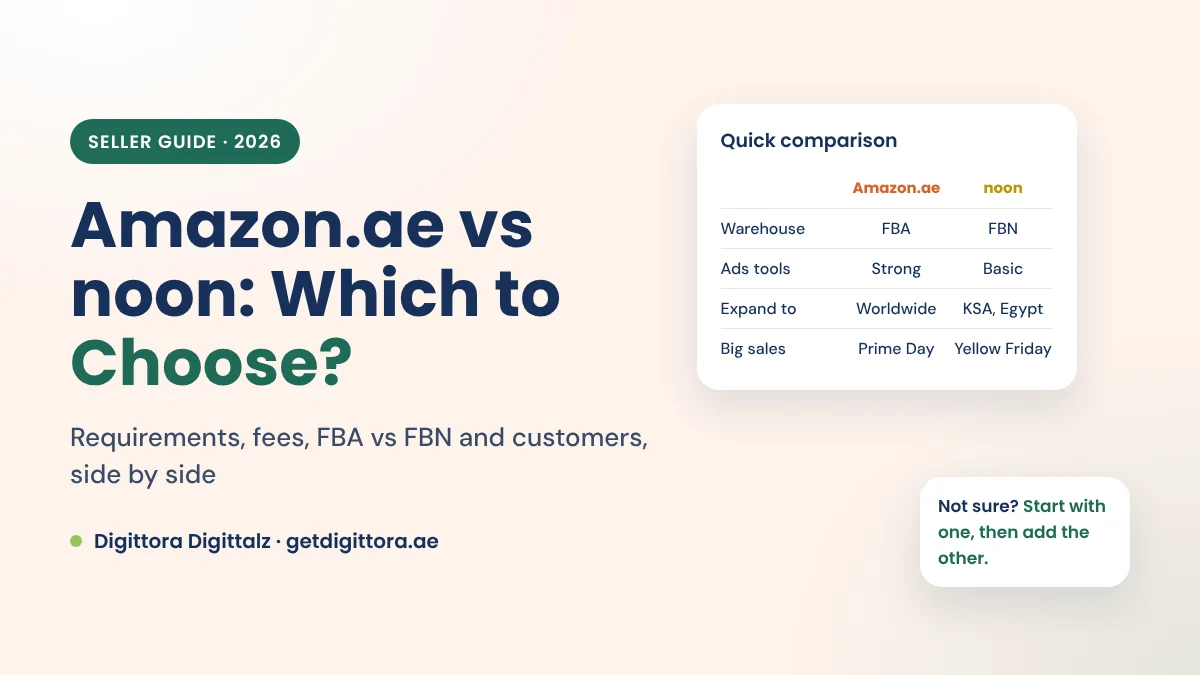
  • Amazon.ae vs noon in 2026: Which Marketplace Should UAE Sellers Choose?

    Amazon.ae vs noon in 2026: Which Marketplace Should UAE Sellers Choose?

    If you want to sell online in the UAE, two names come up first: Amazon.ae and noon. Both are busy, both deliver fast across the Emirates, and both want your products. But they work differently, they charge differently, and they suit different kinds of sellers.

    I manage Amazon accounts for sellers in the UAE, and “Amazon or noon?” is one of the first questions new clients ask me. This Amazon vs noon guide gives you a clear side-by-side view so you can see which one fits your products, and when it makes sense to sell on both.

    Amazon.ae and noon at a glance

    Amazon.ae is the UAE store of Amazon, with Amazon’s seller tools, advertising and Prime delivery. noon is a homegrown marketplace that started in the region and has a strong local following, especially for fashion, beauty, electronics and daily essentials.

    Amazon.aenoon
    RootsGlobal company, UAE storeRegional, built for the Gulf
    Who you need to beA UAE-licensed business (sellers abroad can also join through Amazon Global Selling)A business registered in the UAE, Saudi Arabia or Egypt
    Commission (referral fee)Varies by category, a percentage of the sale priceVaries by category, from about 4% to 27%
    Warehouse optionFulfilment by Amazon (FBA)Fulfilled by noon (FBN)
    AdvertisingSponsored Products, Sponsored Brands and morenoon ads, a smaller ad system
    ExpansionSaudi Arabia and other Amazon stores worldwideSaudi Arabia and Egypt

    Figures come from Amazon’s Global Selling page, noon’s Partner help centre and a 2026 guide by Meydan Free Zone. Fees change often, so always confirm the current rate for your category before you set prices.

    What you need to sell on either marketplace

    The basic requirements are similar. In most cases you need a UAE trade licence that covers the products you sell, a business bank account in the company’s name, your Emirates ID and passport, and a VAT certificate if you are registered (Business Dubai). Some product types, such as cosmetics, food, supplements and children’s items, also need approvals before either marketplace will list them.

    If you are still at this stage, my guide on how to sell on Amazon UAE explains the steps in order.

    Fees: which one costs more?

    Neither marketplace is simply “cheaper”. It depends on your category, your product size and how you ship. Both charge a commission on each sale, and both charge for storage and delivery if you use their warehouses.

    • noon lists commissions from about 4% up to 27% depending on the category. For example, noon’s help centre shows apparel at 27% of the sale price, and FBN delivery for a standard parcel of 0.5 to 1 kg at AED 10.50 per unit for items over AED 25 (noon Partners).
    • Amazon.ae also charges a referral fee by category, plus FBA fees by size and weight if Amazon stores and ships for you. Amazon is currently offering new UAE sellers incentives such as an ad credit for Sponsored Products (Amazon Global Selling).

    The real number that matters is what you keep after commission, delivery, storage, returns, ads and 5% VAT on fees. Two products in the same category can have very different margins on each marketplace. This is the first thing I calculate for a new client, because guessing here is the fastest way to lose money.

    Shipping: FBA vs FBN

    Both marketplaces let you send stock to their warehouses so they can pack and deliver for you. Amazon calls this FBA. noon calls it FBN. Both also let you ship orders yourself.

    • Warehouse shipping (FBA or FBN) gives you fast delivery badges and less daily work, but you pay storage fees, and slow-selling stock gets expensive over time.
    • Shipping yourself keeps storage costs low and works for bulky or slow items, but you handle packing, couriers and returns.

    Many sellers use warehouse shipping for their best sellers and ship the rest themselves. Getting this mix right has a big effect on profit.

    Customers and competition

    Amazon says over 46% of the UAE population bought online in 2024, with an average spend of about USD 1,590 per customer (Amazon Global Selling). Both marketplaces share this audience, but buyers behave a little differently.

    • Amazon.ae buyers often compare reviews, ratings and Prime delivery closely. Strong listings and ads matter a lot.
    • noon buyers respond well to price, sales events and local promotions such as Yellow Friday and Ramadan offers.

    Competition depends on your category. Some categories are crowded on Amazon and quieter on noon, and the reverse is also true. Checking the top sellers for your product on both marketplaces before you start tells you a lot.

    Amazon vs noon: which one should you choose?

    Here is a simple way to think about it.

    • Start with Amazon.ae if you have your own brand, want to run ads, care about reviews, or plan to expand to Saudi Arabia or other Amazon stores later.
    • Start with noon if you sell price-sensitive everyday products, fashion or electronics, and want to join big local sales events.
    • Sell on both once one marketplace is running smoothly. Many UAE sellers do this, but running two stores doubles the listings, stock planning and customer messages to manage.

    My honest advice is to master one marketplace first. Splitting your time and stock across two stores too early is one of the most common reasons new sellers struggle.

    Questions to answer before you decide

    Before you register anywhere, it helps to answer a few honest questions about your business. Your answers usually point clearly to one marketplace.

    • Do you own a brand or a trademark? Brand owners get extra protection and content tools on Amazon.
    • How much can you spend on ads each month? Some categories need steady ad spend from day one to get seen.
    • How big and heavy are your products? Size changes warehouse and delivery fees a lot on both marketplaces.
    • How fast does your stock sell? Slow sellers can build up storage fees in a warehouse.
    • Do you want to sell outside the UAE later? Amazon opens doors to many countries; noon focuses on the Gulf and Egypt.
    • Who will handle listings, stock and messages every day? A store that is left alone for weeks quickly drops in search.

    If you are unsure about two or more of these, it is worth getting a second opinion before you spend on stock and fees.

    Common mistakes new UAE sellers make

    • Choosing a marketplace before checking real margins for their category.
    • Copying the same listing from one marketplace to the other without changing it.
    • Sending too much stock to a warehouse and paying storage fees on slow sellers.
    • Starting ads before the listing, images and reviews are ready.
    • Ignoring account health warnings until the account is at risk.

    Each of these can cost thousands of dirhams in the first few months, and most can be avoided with the right setup.

    How I can help

    I help UAE sellers set up and run their Amazon stores: account registration, listings that convert, stock planning and Amazon ads. If you are not sure which marketplace suits you, I will look at your products and tell you honestly. See my Amazon seller account and management services, my Amazon PPC and listing optimization page, and prices on my pricing page.

    Frequently asked questions

    Is it better to sell on Amazon or noon in the UAE?

    It depends on your products. Amazon.ae suits branded products, sellers who want to run ads and those planning to expand to other Amazon stores. noon suits price-driven everyday products and sellers who want to join local sales events. Many sellers end up on both.

    Can I sell on Amazon.ae and noon at the same time?

    Yes. Many UAE sellers list on both. It works best once one store is running well, because two stores mean more listings, stock and customer messages to manage.

    Do I need a trade licence to sell on noon or Amazon UAE?

    In most cases, yes. You need a UAE trade licence that covers your products, plus a business bank account and your ID documents. Some product types also need extra approvals.

    Which marketplace has lower fees?

    Neither is always cheaper. Commissions vary by category on both, and warehouse fees depend on size and weight. Compare the full cost for your specific product, including ads and returns.

    Can noon sellers also sell in Saudi Arabia?

    Yes. noon operates in the UAE, Saudi Arabia and Egypt. Amazon also has a Saudi store, Amazon.sa, which you can add from Seller Central.

    Not sure where to start?

    Tell me what you sell and where you buy your stock. I will reply on WhatsApp with which marketplace I would start with, and why.

    Sources

  • Is SEO Dead in 2026? What Still Works for UAE Businesses in the Age of AI

    Is SEO Dead in 2026? What Still Works for UAE Businesses in the Age of AI

    Every few months someone announces that SEO is dead. In 2026 the reason is AI. Google now shows AI Overviews at the top of many searches, ChatGPT answers questions directly, and business owners in Dubai and Sharjah are asking me the same thing: “Is it still worth paying for SEO?”

    So, is SEO dead? The short answer is no, but SEO has changed. Some old tricks have stopped working, and some new things matter more than ever. This guide explains what changed, what still brings customers to UAE businesses, and where most owners go wrong.

    Why people say SEO is dead

    The worry is real. According to SparkToro data reported in June 2026, about 68% of Google searches in the US ended without a click in early 2026, up from about 60% in 2024 (TechWyse). AI Overviews appear on a growing share of searches and give people an answer before they see any website.

    So yes, some searches that used to send visitors now send fewer. A blog post that answers “what is VAT in the UAE” may lose clicks, because Google answers that question itself.

    But look at what kind of searches lose clicks. Most of them are simple facts and definitions. Searches where people want to buy, book or hire are different. Someone searching “AC repair Ajman” or “Amazon account manager UAE” still wants a business, not just an answer.

    What the data really shows

    A 2026 study by Seer Interactive looked at 5.47 million searches across 53 brands (Search Engine Land). Three findings matter for UAE businesses:

    • Click rates did drop when an AI Overview appeared, but they started to recover in early 2026.
    • Pages that were cited inside the AI Overview got more than twice the clicks of pages on the same results page that were not cited.
    • Searches without an AI Overview still had the highest click rates of all.

    In other words, AI did not remove the prize. It changed who wins it. The businesses Google trusts enough to quote are the ones still getting the clicks.

    Does Google need a new kind of SEO for AI?

    No. This surprises a lot of people. Google says there are “no additional requirements to appear in AI Overviews or AI Mode” (Google Search Central). The same things that help a page rank in normal search also help it appear in AI answers: helpful content written for people, a page Google can crawl and index, clear text, good internal links and a correct Google Business Profile.

    So when someone sells you a separate “AI SEO package” with special files or secret markup, be careful. Google says it does not require new AI files or special schema to show up in its AI features.

    What still works for UAE businesses in 2026

    Here is the overview. Each point sounds simple, but the details are where most businesses lose rankings, and where a specialist earns their fee.

    1. Local SEO and Google Maps

    For service businesses, the map results are still the biggest source of calls. AI answers about local services pull heavily from Google Business Profiles and reviews. A complete, active profile with recent reviews helps you in both places. I cover this in detail on my local SEO packages page.

    2. Pages that answer buying questions

    AI can answer “what is SEO”. It cannot quote your prices, your delivery areas or your opening hours unless your website states them clearly. Service pages that answer real customer questions in plain English, with prices in AED where you can, give Google something to cite.

    3. Real experience and proof

    Google keeps rewarding content that shows real first-hand experience: your own photos, real results, named authors and honest answers. Generic AI-written articles are now everywhere, so content that clearly comes from a real UAE business stands out more, not less.

    4. A fast, clean, technically healthy site

    If Google cannot crawl a page, it cannot rank it or quote it. Slow pages, broken links, missing pages in the sitemap and blocked crawlers quietly cost rankings every month. Most owners never notice until traffic drops.

    5. Being mentioned on other trusted sites

    Links and mentions from relevant UAE directories, news sites and industry blogs still help Google decide who to trust. The difference in 2026 is quality. A few real mentions beat hundreds of cheap links, which can now do more harm than good.

    What no longer works

    • Keyword stuffing. Repeating “best SEO company Dubai” twenty times on a page no longer helps and can hurt.
    • Mass AI articles with no expertise. Publishing 100 thin posts a month rarely brings customers and can lower trust in your whole site.
    • Bulk backlink packages. “500 links for AED 300” deals usually come from networks Google ignores or penalises.
    • Ranking for words nobody buys from. Traffic that never calls or orders is a vanity number, not a result.

    Is SEO still worth paying for in Dubai?

    For most UAE businesses, yes, if it is done properly and measured by calls, leads and sales rather than traffic alone. Google itself says SEO usually takes four months to a year to show its full effect (Google Search Central), so it works best as a steady investment, not a quick fix.

    The cost depends on your competition and goals. I broke down typical AED prices in my guide to SEO cost in Dubai. If you are still deciding who to work with, my guide to choosing a marketing agency in Dubai lists the red flags to avoid.

    Signs your SEO needs attention in 2026

    You do not need special tools to spot most problems. If any of these sound familiar, your site is probably losing customers to competitors that keep their SEO up to date.

    • Calls and enquiries from Google have dropped, even though your business is just as busy offline.
    • Competitors show up in the Google Maps top three for your main service, and you do not.
    • When you search your own service and area, an AI Overview mentions other businesses but not yours.
    • Your website has not been updated in over a year, or your prices and services on it are out of date.
    • You have paid for “SEO” before but never received a clear report showing what changed.
    • Your Google Business Profile has few recent reviews, or reviews with no reply.

    Any one of these is worth checking. Two or more usually means there is real money being left on the table every month.

    Why most businesses get stuck doing it alone

    The ideas above are simple to read and hard to do well. Knowing which pages Google is quoting, which keywords bring buyers, what is slowing your site down, and which links are safe takes tools, time and experience. Most owners I talk to have tried a few changes themselves, seen no movement, and given up after a couple of months.

    That is where I can help. I check where your business stands today in Google search, Google Maps and AI answers, then give you a clear plan in priority order. You can see how I work on my SEO services page and compare packages on my pricing page.

    Frequently asked questions

    Is SEO dead now with AI?

    No. AI has changed how people search, but Google still sends most of its clicks to websites, and its AI answers are built from the same pages that rank in normal search. SEO now focuses more on trust, local signals and pages that answer buying questions.

    Do I need special SEO for AI Overviews?

    Google says there are no extra requirements to appear in AI Overviews or AI Mode. Good normal SEO, a crawlable site and a complete Google Business Profile are what help you show up.

    Is SEO in demand in Dubai?

    Yes. Most UAE customers still search on Google before they call or visit a business, and many sectors in Dubai are very competitive online. Businesses that stop investing in SEO usually lose ground to competitors that keep going.

    Will ChatGPT replace Google for UAE customers?

    Not soon. More people use AI tools for research, but Google still handles far more local and buying searches. A strong website and Google Business Profile help you in both places.

    How long does SEO take to work in 2026?

    Usually four months to a year for meaningful results, depending on your competition and your site. Local SEO and fixes to existing pages often show changes sooner.

    Want to know where you stand?

    Send me your website and your main service on WhatsApp. I will tell you honestly whether SEO is worth it for your business right now, and what I would fix first.

    Sources

  • How to Choose a Digital Marketing Agency in Dubai: 9 Red Flags

    How to Choose a Digital Marketing Agency in Dubai: 9 Red Flags

    Hiring the wrong marketing partner is expensive. You lose the monthly fees, and you also lose months of time, sometimes your ad account, and in the worst cases your Amazon seller account.

    To write this guide, I read through the lowest-rated Google reviews of marketing agencies and Amazon consultants in Dubai, Sharjah and Ajman, plus public reviews from business owners online. The same complaints came up again and again. Below are the nine red flags to look for, the questions to ask before you pay, and what a fair deal looks like.

    Why choosing the right partner matters

    Marketing results take time. Google says SEO usually takes “four months to a year” before you see the benefits (Google Search Central). If you pick the wrong provider, you often only find out after several months of payments. One Dubai business owner described spending about AED 30,000 on Google Ads with an agency and getting no sales, because nobody added negative keywords or filtered out bad clicks (DEV Community).

    The good news is that most bad deals show warning signs before you sign. Here is what to watch for.

    9 red flags when you choose a digital marketing agency in Dubai

    1. A long contract you cannot leave

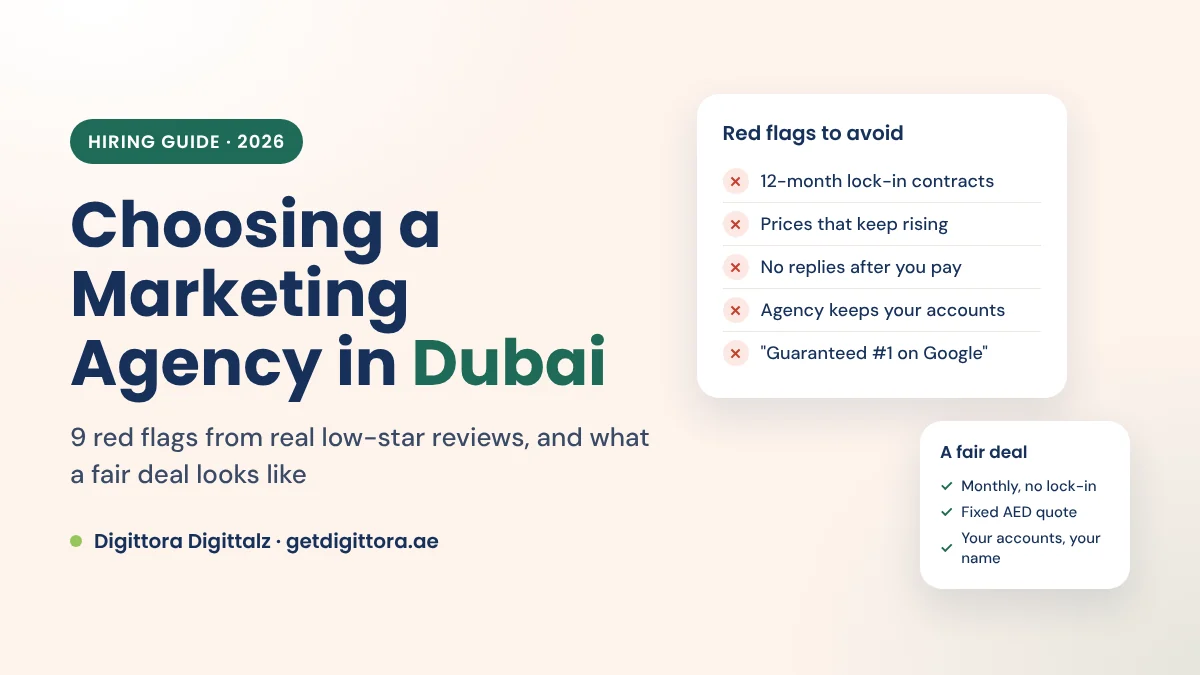
    Several of the 1-star reviews I read describe 12-month contracts, two months paid upfront and post-dated cheques that made it hard to leave when results did not come. A review of Dubai SEO quotes by Kolonell lists the 24-month, non-cancellable contract as one of the biggest traps. A good provider is confident enough to work month by month.

    2. Prices that keep going up

    One reviewer described a job quoted in the hundreds that grew to thousands, then to more again. Always ask for a written quote in AED that lists exactly what is included each month, and what would cost extra.

    3. Nobody replies after you pay

    “No reply” was the most common complaint in the low reviews: messages ignored, calls not returned, and in one case a client chasing an agency for three months. Before you sign, notice how fast they reply. Ask who you will actually speak to each week.

    4. The agency keeps your accounts

    Some agencies create your Google Ads account, Google Business Profile or website hosting in their own name. When you leave, you can lose your ad history, your reviews or even your website. One reviewer said the agency kept the ads account after the contract ended. Your accounts should always be in your name, with the provider added as a user.

    5. “Guaranteed #1 on Google”

    No one controls Google’s rankings. Google itself says no one can guarantee a #1 ranking (Google Search Central). A guarantee is usually a sign of tricks that can hurt your site later, or of rankings for words nobody searches.

    6. Huge numbers of cheap backlinks

    “50 backlinks a month” sounds good, but large numbers of cheap links usually come from link farms or paid networks. Google’s spam policies treat these as link schemes, and they can lead to a ranking drop. Ask to see examples of the websites where links will be placed.

    7. Reports full of jargon and vanity numbers

    A 20-page PDF full of charts can still hide the fact that nothing improved. Clicks and impressions mean little if calls, leads or sales did not grow. A good monthly report fits on one or two pages and answers three questions: what was done, what changed, and what happens next.

    8. Risky shortcuts on Amazon

    Amazon sellers face a special risk. Public reviews of some Amazon consultancies describe suspended accounts, inventory that was held, and supplier invoices that Amazon would not accept (Trustpilot). Avoid anyone who offers paid reviews, review swaps or “guaranteed” ways around Amazon’s rules. Ask how they protect your Account Health.

    9. No real reviews or references

    Almost every agency on Google Maps shows 4.8 or 5 stars, so a high rating alone tells you little. Read the 1 to 3-star reviews and the owner’s replies. Look for detailed reviews that mention a service and a result, and ask for one or two past clients you can contact.

    How to read an agency’s Google reviews

    • Sort by lowest rating. On Google Maps, open the Reviews tab, tap Sort and choose Lowest rating. The complaints there tell you more than fifty short 5-star reviews.
    • Look for patterns. One angry review can be a misunderstanding. Three reviews that mention contracts, refunds or no replies are a pattern.
    • Read the owner’s replies. A calm reply that explains what went wrong is a good sign. A reply that blames or threatens the customer is not.
    • Check the dates. Recent reviews matter more than ones from five years ago, because teams and owners change.
    • Prefer detailed reviews. “Great service” says little. “They fixed our Google Business Profile and calls doubled in three months” is the kind of review that is hard to fake.

    Already stuck in a bad contract?

    If you are unhappy with your current provider, first ask for admin access to every account they manage: Google Ads, Search Console, Google Analytics, Google Business Profile, your domain, hosting and Seller Central. Take screenshots of your current results so you have a clear starting point. Then read the cancellation terms in your contract and ask for any exit options in writing. If the contract is unclear, a short consultation with a lawyer can save you money in the long run.

    Questions to ask before you pay

    1. Is there a minimum contract? How do I cancel?
    2. Is the price fixed? What exactly is included each month, and what costs extra?
    3. Will my Google Ads, Search Console, Analytics, website and Seller Central stay in my name?
    4. Who will I talk to every week, and how fast do you reply?
    5. What will the monthly report show me?
    6. Where will links be placed? Can I see examples?
    7. What will you do in the first 30, 60 and 90 days?
    8. Can I speak to a past client?

    Freelancer or agency: which is safer?

    FreelancerAgency
    Who does the workThe person you talk toOften a junior team member
    How you reach themDirectly, often on WhatsAppThrough an account manager
    Typical contractMonthly or project-basedOften 6 to 12 months
    Monthly cost in DubaiUsually lower, no office overheadsUsually higher
    CapacityLimited number of clientsBigger team for many channels at once

    Neither choice is safe by default. A careless freelancer can cause the same problems as a bad agency. What matters is the terms: a short contract, a fixed price, accounts in your name and clear reports. For typical price ranges, see my guide to SEO cost in Dubai.

    What a fair deal looks like

    • You pay monthly, in advance, with no long lock-in.
    • You get a written quote in AED before work starts.
    • All your accounts and content stay in your name.
    • You can reach the person doing the work, and they reply within a working day.
    • You get a short, plain-language report every month.
    • Nobody promises #1 rankings, guaranteed sales or “safe” ways to break platform rules.

    How I work

    I’m a freelance SEO and Amazon specialist based in Ajman, and these are the terms I offer every client. You can read them as my promises on the homepage, see every package on my pricing page, or learn more about my Amazon account management and SEO services.

    Frequently asked questions

    How do I choose a digital marketing agency in Dubai?

    Check their recent low-star reviews, ask for a written quote in AED, confirm there is no long lock-in, make sure all accounts stay in your name, and ask what their monthly report includes. A short paid trial month tells you more than any sales pitch.

    Is it normal to sign a 12-month marketing contract in the UAE?

    Many agencies ask for 6 to 12 months, but it is not required. Plenty of freelancers and some agencies work monthly. If you do sign a long contract, ask for an exit clause after the first three to six months.

    Should my Google Ads account be in my name?

    Yes. Create the account with your own email and add your provider as a user. That way you keep your data, history and billing control if you change providers.

    Can an SEO agency guarantee first page rankings?

    No. Google says no one can guarantee a #1 ranking. Treat any guarantee as a warning sign.

    How much should I pay for digital marketing in Dubai?

    It depends on the service and your competition. Published 2026 guides put local SEO at about AED 1,500 to 5,000 a month, and SME SEO retainers at about AED 3,500 to 12,000. Your ad budget is always separate from the management fee.

    What should a monthly marketing report include?

    What work was done, the key numbers (leads, calls, sales, rankings or ACOS), how they changed since last month, and the plan for next month. It should be short enough to read in five minutes.

    Sources

  • SEO Cost in Dubai: What You’ll Really Pay in 2026

    SEO Cost in Dubai: What You’ll Really Pay in 2026

    Ask five SEO providers in Dubai for a price and you could get five very different answers, from a few hundred dirhams to tens of thousands a month. That makes it hard to know what a fair price looks like, or what you’re actually paying for.

    This guide breaks down the SEO cost in Dubai using price ranges published by UAE agencies in 2026. You’ll see what each budget usually covers, which extra costs to plan for, and the warning signs in a bad quote. I’m a freelance SEO specialist based in Ajman, so I’ll also share my own starting prices at the end.

    Quick answer: what SEO costs in Dubai

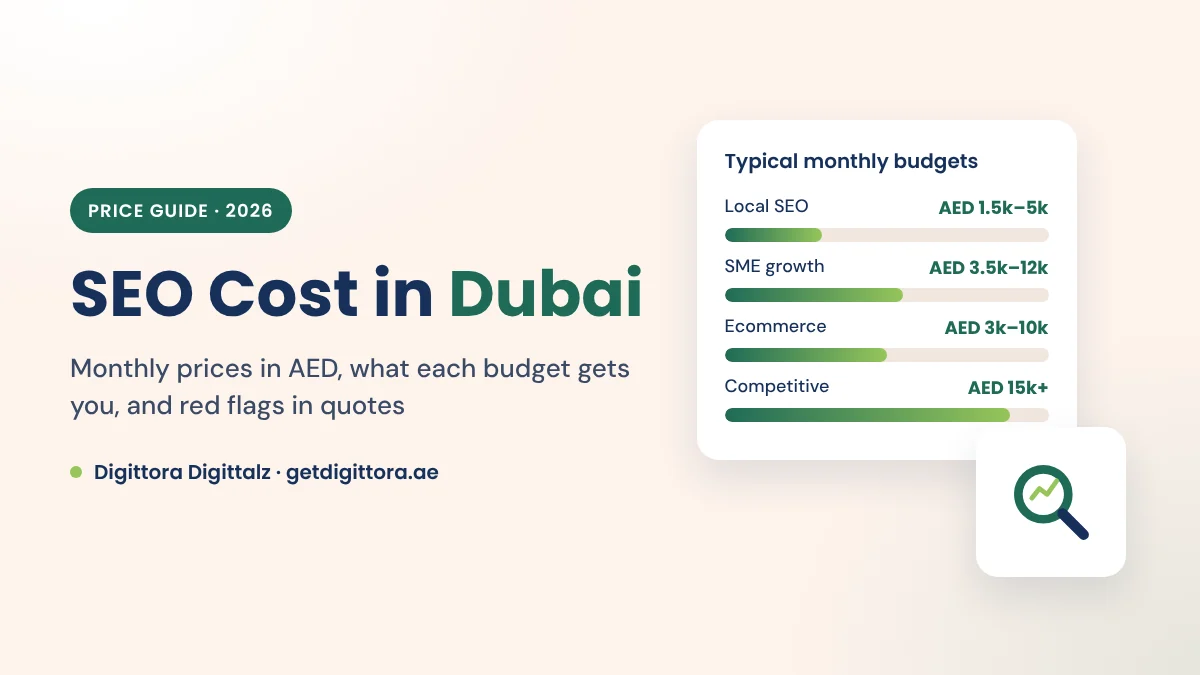
    Type of SEO workTypical price in 2026Source
    Local SEO (one location)AED 1,500 to 5,000 a monthGlobal Media Insight
    Basic or local retainerAED 1,500 to 3,500 a monthPrism
    Growth retainer for SMEsAED 3,500 to 12,000 a monthPrism
    Ecommerce SEOAED 3,000 to 10,000 a monthGlobal Media Insight
    Competitive sectors (legal, medical, real estate)AED 15,000 to 40,000+ a monthPrism
    International SEOAED 10,000 to 50,000 a monthGlobal Media Insight
    Freelance consultant, hourlyAbout AED 150 to 500+ an hourDubai consultant price guide

    Most of these prices don’t include 5% VAT, so check whether a quote is “plus VAT” before you compare. Your ad budget for Google Ads is also separate from SEO.

    Why SEO prices vary so much

    Two businesses on the same street in Business Bay can need very different amounts of work. Global Media Insight and Prism list the same main factors:

    • Competition: a dentist or property firm competes with big budgets, so it needs more content and links than a tailoring shop in Ajman.
    • Website size and health: a 10-page site with clean code is quicker to fix than a 2,000-product store with speed and indexing problems.
    • Languages: Arabic and English pages double the content work. Native Arabic content costs about AED 400 to 900 per page, according to Kolonell.
    • Target area: ranking in one emirate costs less than ranking across the GCC or worldwide.
    • Content needs: new service pages, blog posts and product descriptions all take writing time.
    • Speed: if you want results faster, more work has to happen each month.

    What each budget usually gets you

    Under AED 1,500 a month

    At this level, expect a small amount of focused work: an audit, a few page fixes, or Google Business Profile updates. That can be enough for a very small local business. Be careful with full “SEO packages” at this price. To make the numbers work, some providers buy cheap links or use automated content, and that can do more harm than good.

    AED 1,500 to 5,000 a month

    This is the typical range for local SEO packages in Dubai. It usually covers your Google Business Profile, local listings, on-page fixes for your main service pages, a few new pieces of content and a monthly report. It suits single-location businesses such as clinics, salons, repair services and restaurants in Dubai, Sharjah or Ajman.

    AED 5,000 to 15,000 a month

    At this level you get more of everything: regular content, technical SEO work, link building and keyword tracking across many pages. This is common for growing B2B firms, ecommerce stores and businesses in busy sectors.

    AED 15,000 and above

    Large budgets are for very competitive sectors, big online stores, and brands that want to rank across several emirates or GCC countries in both Arabic and English.

    How SEO is priced

    • Monthly retainer: the most common model. You pay a fixed fee for ongoing work.
    • One-off project: a fixed price for a set job, such as an SEO audit, a site migration or fixing technical errors.
    • Hourly: common with freelancers for advice, training or small tasks.
    • Performance-based: fees tied to rankings or traffic. This sounds safe, but read the terms carefully. Rankings for terms nobody searches are easy to “win”.

    One-off costs to plan for

    Monthly fees aren’t the only cost. Plan for these as well:

    • SEO audit: a full check of your site’s technical health, content and links before work starts.
    • Setup or onboarding fees: Kolonell found these range from AED 2,000 to 12,000 in Dubai. Ask what they cover.
    • Website fixes: some problems need a developer, such as slow hosting or a broken theme.
    • Content: new service pages, blog posts or Arabic translations if they aren’t in the package.
    • Tools: most providers include tools such as Semrush or Ahrefs. If you do SEO yourself, these cost extra.

    Freelancer or agency: which costs less?

    A freelancer usually costs less because there’s no office or account manager to pay for, and you speak to the person doing the work. An agency gives you a bigger team, which helps if you need SEO, ads, video and design all at once. For most small and medium UAE businesses, a good freelancer covers SEO well. You can compare both in more detail on my homepage.

    Red flags in an SEO quote

    These warning signs come up again and again in Dubai quotes, based on Kolonell’s review of SEO quotes and Google’s own guidance:

    • Guaranteed #1 rankings: Google says no one can guarantee a #1 ranking.
    • Long contracts you can’t cancel: a 24-month lock-in with no exit is a bad sign. Look for a notice period after the first few months.
    • “50 backlinks a month”: large link counts usually mean low-quality or paid links, which Google’s spam policies treat as link schemes.
    • No access to your own data: you should always own your Google Search Console and Google Analytics 4 accounts.
    • Unclear content ownership: make sure the content you pay for belongs to you, even if you stop the service.
    • Big setup fees with no details: ask for a list of what the setup includes.

    Good link building is slow and careful. If you want to see how it should be done, I explain my process on the link building services page.

    How long before SEO pays off?

    Google says SEO usually takes “four months to a year” to show benefits after changes are made (Google Search Central). Prism says most UAE businesses see real progress in 3 to 6 months, and competitive sectors can take 6 to 9 months. Local SEO for a single location is often the quickest win. This is why a fair way to judge a provider is to look at progress after three months, not one. If you are worried AI answers will make SEO pointless, read my take on SEO and AI search in 2026.

    How to get the most from a small budget

    1. Set up and complete your free Google Business Profile first.
    2. Fix technical issues such as slow pages, broken links and missing titles.
    3. Target specific searches, such as “AC repair in Al Nahda”, before broad ones like “AC repair Dubai”.
    4. Write one strong page for each service instead of one page that lists everything.
    5. Ask happy customers for Google reviews in a way that follows Google’s rules.
    6. Check Google Search Console every month to see which searches bring visitors.

    Google handles the large majority of searches in the UAE, according to StatCounter, so even small improvements on Google can bring real enquiries.

    My SEO prices

    I’m a freelancer, so my prices are lower than most Dubai agencies. These are starting prices. You get a fixed quote after a free audit.

    ServiceStarting price
    SEO audit (one-off)AED 499
    Local SEOAED 1,500 a month
    SEO GrowthAED 2,500 a month
    SEO ProAED 4,500 a month
    Link buildingAED 250 per link

    See what’s included in each package on my pricing page, or read about my SEO services in Dubai.

    Frequently asked questions

    How much does SEO cost per month in Dubai?

    Published 2026 price guides put local SEO at about AED 1,500 to 5,000 a month, SME retainers at about AED 3,500 to 12,000, and competitive sectors at AED 15,000 or more. The right budget depends on your competition, website and goals.

    How much does local SEO cost in Dubai?

    Local SEO for one location usually costs AED 1,500 to 5,000 a month. It covers your Google Business Profile, local listings, reviews and on-page fixes for your main service pages.

    Is SEO worth it for a small business in the UAE?

    For most businesses, yes, because people search on Google before they buy or call. SEO takes months to build, but the visitors keep coming without paying for each click, unlike ads.

    Why are some SEO packages so cheap?

    Very cheap packages often rely on automated content or bought links to keep costs down. These can break Google’s spam policies and hurt your rankings. Always ask exactly what work is done each month.

    Do SEO prices in the UAE include VAT?

    Usually not. Most quotes are “plus 5% VAT”, so check before you compare prices from different providers.

    Can I do SEO myself?

    Yes, you can handle the basics yourself: your Google Business Profile, page titles, helpful content and asking for reviews. Technical fixes, link building and competitive keywords usually need more time and tools.

    What does an SEO audit include?

    A good audit checks site speed, indexing, page titles and headings, content gaps, links and your Google Business Profile, then gives you a list of fixes in order of importance.

    Related reading

    Selling products online too? Read my step-by-step guide on how to sell on Amazon UAE.

    Sources

  • How to Sell on Amazon UAE: A Step-by-Step Guide for 2026

    How to Sell on Amazon UAE: A Step-by-Step Guide for 2026

    Selling on Amazon.ae is one of the quickest ways to reach shoppers across the Emirates. You don’t need a shop, a warehouse or a big team to get started. You do need the right documents, a clear view of your costs, and product pages that buyers trust.

    I’m Syeda Maleeha, a freelance Amazon account manager based in Ajman. This guide shows you how to sell on Amazon UAE step by step, from your trade licence to your first order. It uses Amazon’s own figures and the questions new sellers ask most often on forums and in my WhatsApp chats.

    Why sell on Amazon.ae?

    Amazon took over Souq.com and launched Amazon.ae in May 2019 (Gulf News). Since then, online shopping in the country has grown fast. The UAE e-commerce market reached AED 42.2 billion in 2025, based on Euromonitor data shared by Dubai South.

    Amazon takes care of payments and customer trust, and it can also handle storage and delivery for you. That means a small brand from Sharjah can appear on the same search page as a global name. The trade-off is that fees cut into your margin, popular categories are crowded, and Amazon’s rules are strict. Knowing this before you start will save you money.

    What you need before you register

    Amazon’s UAE sign-up and the free zones that partner with Amazon list the same core items (Khaleej Times, Blooprint):

    • A valid trade licence (e-commerce or general trading), or a power of attorney if you sign up for a company you represent
    • Your Emirates ID, or passport details for non-residents
    • A credit card that Amazon can charge
    • A bank account to receive your sales money
    • A phone number and an email address you check often
    • Your VAT registration number, if you are registered

    The question I hear most is, “Can I sell without a trade licence?” If you live in the UAE, plan on getting one. Amazon’s UAE sign-up asks for it, and its partner free zones exist to help sellers get licensed. Sellers based outside the UAE can often sell through Amazon Global Selling using their home-country business instead.

    Which licence should you choose?

    Licence typeTypical cost (2026 estimates)Best for
    Free zone e-commerce licenceFrom about AED 5,500 to 10,000 a yearMost new Amazon sellers
    Mainland licenceAbout AED 12,000 to 18,000Sellers who also want a shop or local B2B sales
    e-Trader licence (Dubai)About AED 1,070 to 1,500Home-based sellers (only certain nationalities and activities)

    These ranges come from SPC Free Zone and published free zone price lists, such as RAKEZ at AED 5,499. Prices change and depend on visas and business activities, so always confirm with the free zone before you pay.

    Step 1: Choose your selling plan

    Amazon.ae has two plans:

    • Individual: for sellers who expect to sell fewer than 40 items a month.
    • Professional: for more than 40 items a month. It adds advertising, bulk listing tools and business reports. Amazon says Professional accounts are currently available with no monthly subscription fee, for a limited time.

    My advice is to pick Professional if you plan to run Amazon ads or sell more than a few products. Sponsored Products ads are only available on the Professional plan, and most products need some ad support in the first few months.

    Step 2: Register on Seller Central

    Go to sell.amazon.ae and click Sign up. You’ll log in with an Amazon account (or create one), then enter your business details, upload your documents and add your card and bank details. Amazon may also ask for a short video call to check your ID.

    Sellers usually report approval in 2 to 5 working days (SPC Free Zone). The most common cause of delays is details that don’t match. The name and address on your trade licence, bank statement and Emirates ID should be the same, letter for letter. If you’d like someone to handle this part, my Amazon seller account setup service covers the documents, verification and first listings.

    Step 3: Pick products that can make a profit

    Do the maths before you order stock. Your selling price has to cover the product cost, shipping to the UAE, customs duty (usually 5% on imported goods), Amazon’s fees, VAT and your ad budget, and still leave a profit.

    • Use the FBA Revenue Calculator inside Seller Central to estimate fees for each product.
    • Check search demand and competition with tools like Helium 10 or Jungle Scout.
    • Look at the top 10 sellers for your main search term. If they all have thousands of reviews, a new listing will struggle.
    • Small, light products usually have lower fulfilment fees and cheaper shipping.
    • Some categories need Amazon’s approval before you can list, so check this in Seller Central first.

    Step 4: Create listings that sell

    A good listing answers a buyer’s questions before they ask. Here’s what to get right:

    • Title: brand, product name, the main feature and size or quantity. Keep it readable, not stuffed with search terms.
    • Bullet points: five short points on benefits, materials, sizes and what’s in the box.
    • Images: the main image must have a pure white background. Add lifestyle photos, size charts and close-ups.
    • Backend search terms: extra words buyers use, including spelling variations, that don’t fit in the title.
    • Arabic content: Amazon.ae also shows listings in Arabic. A clean Arabic translation reaches more local shoppers.

    If you own a registered trademark, enrol in Amazon Brand Registry. It protects your brand from copycats and gives you access to A+ Content, the extra images and comparison charts below the bullet points.

    Amazon A+ Content designed for bamboo drawer dividers
    An example of A+ Content I designed for a home organisation brand.

    Listing work and ads go hand in hand, which is why I cover both on my Amazon PPC and listing optimization page.

    Step 5: Choose how you’ll ship orders

    OptionHow it worksCost starts from
    Fulfilment by Amazon (FBA)You send stock to Amazon. Amazon stores, packs, delivers and handles returns.AED 7.5 per unit, by size
    Easy ShipYou store and pack. Amazon collects the parcel and delivers it.AED 14 per shipment
    Self-ShipYou store, pack and deliver with your own courier.Your own courier rates

    Fee figures are from Amazon.ae’s pricing page as quoted by Blooprint, and Amazon adds VAT on top. FBA products can show the Prime badge, which helps sales. Easy Ship or Self-Ship can work better for bulky or slow-selling items, where storage fees add up.

    Step 6: Understand the fees

    • Referral fee: mostly 4.5% to 15% of the selling price, with a minimum of AED 1, depending on the category.
    • Fulfilment fees: FBA or Easy Ship fees as above, plus monthly storage fees for stock in Amazon’s warehouse.
    • Subscription: currently no monthly fee on the Professional plan, as a limited-time offer.
    • Advertising: you set your own daily budget.
    • VAT: Amazon charges 5% VAT on its fees.

    Here’s a simple example. Say you sell a product for AED 100. A 10% referral fee is AED 10. If the FBA fee is AED 12, your product and shipping cost AED 40 and you spend AED 10 on ads, you keep about AED 28 before tax. Real fees depend on your category and product size, so always run your own numbers.

    Step 7: VAT and corporate tax basics

    VAT registration is mandatory once your taxable sales pass AED 375,000 in 12 months, and you can register by choice from AED 187,500 (Federal Tax Authority). UAE corporate tax is 9% on taxable profit above AED 375,000, and some free zone income can qualify for 0% (WAM). Tax rules depend on your setup, so speak to a registered tax agent before you scale.

    Step 8: Launch and keep your account healthy

    • Start Sponsored Products ads on launch day so Amazon learns which searches convert.
    • Track ACOS (ad spend divided by ad sales) and TACOS (ad spend divided by total sales) every week.
    • Never pay for reviews or swap free products for reviews. Amazon bans this and can suspend your account.
    • Keep your Order Defect Rate under 1%, as Amazon expects.
    • Watch your stock levels. Running out of stock can push your listing down the search results.

    Amazon.ae or noon?

    Many UAE sellers list on both. noon is a UAE-based marketplace with a strong local following, while Amazon.ae gives you Amazon’s tools, Prime delivery and the option to expand to Saudi Arabia and other Amazon stores later. If you have limited stock or time, start with one, learn how it works, then add the second. I compare both in more detail in Amazon.ae vs noon: which marketplace to choose.

    Common mistakes new sellers make

    1. Ordering a large batch of stock before testing demand
    2. Forgetting customs duty, VAT and storage fees in the price
    3. Using supplier photos that look like every other listing
    4. Uploading documents with names or addresses that don’t match
    5. Ignoring Account Health warnings until the account is at risk

    Should you do it yourself or get help?

    You can set up and run an account on your own if you have the time to learn Seller Central. Many business owners would rather spend that time on sourcing and sales. My Amazon account setup starts from AED 750, and monthly account management starts from AED 1,200. You can see every package on my pricing page, or read more about how I work on the homepage.

    Frequently asked questions

    Can I sell on Amazon UAE without a trade licence?

    If you are based in the UAE, Amazon’s sign-up asks for a trade licence or a power of attorney for the business. A free zone e-commerce licence is the most common choice. Sellers outside the UAE can often use Amazon Global Selling with their home-country company.

    How much does it cost to start selling on Amazon.ae?

    Plan for a trade licence (from about AED 5,500 a year in many free zones), your first stock, and Amazon’s fees. Referral fees are mostly 4.5% to 15%, FBA starts from AED 7.5 per unit, and the Professional plan currently has no monthly fee for a limited time.

    How long does Amazon UAE seller approval take?

    Sellers usually report 2 to 5 working days once all documents are in. It can take longer if Amazon asks for a video call or extra checks, so make sure your licence, ID and bank details all match.

    Is selling on Amazon UAE profitable?

    It can be, if you choose products with real demand and price them after counting every cost. Many new sellers lose money because they forget fees, customs duty or ad costs. Run the numbers in the FBA Revenue Calculator before you buy stock.

    Do I need to register for VAT to sell on Amazon UAE?

    VAT registration is mandatory once your taxable sales pass AED 375,000 in 12 months. You can register by choice from AED 187,500. Amazon also charges 5% VAT on its own fees.

    Can I sell on Amazon.ae from outside the UAE?

    Yes, in many cases. Amazon Global Selling lets businesses from countries such as India and China sell to UAE shoppers, usually using FBA so Amazon handles local delivery.

    What is the difference between FBA and Easy Ship?

    With FBA, Amazon stores your stock and handles packing, delivery and returns. With Easy Ship, you keep the stock and pack each order, and Amazon collects and delivers it.

    Related reading

    Thinking about Google as well as Amazon? Read what SEO costs in Dubai or see my SEO services.

    Sources