
Amazon PPC Expert
and Listing Optimization for Sellers
Ads bring shoppers to your product. Your listing decides whether they buy. I manage Amazon PPC campaigns and improve listings and A+ Content for sellers on Amazon.ae and other marketplaces, with clear numbers and weekly changes you can follow.
How Amazon PPC works
Amazon ads run on a cost-per-click model. You set a budget and a bid, and you pay when a shopper clicks your ad (Amazon Ads). The main ad types are:
- Sponsored Products: ads for single products that appear in search results and on product pages.
- Sponsored Brands: ads with your logo, a headline and several products. They need Brand Registry.
- Sponsored Display: ads that reach shoppers on and off Amazon who viewed similar products.
To judge ads, I track a few simple numbers:
| Metric | What it means | Example |
|---|---|---|
| ACOS | Ad spend divided by ad sales | AED 300 spend for AED 1,000 sales = 30% |
| TACOS | Ad spend divided by total sales | AED 300 spend for AED 3,000 total sales = 10% |
| ROAS | Ad sales divided by ad spend | AED 1,000 sales for AED 300 spend = 3.3 |
| CTR | Clicks divided by impressions | Shows if your ad and image get attention |
My Amazon PPC process
- Audit. I read your search term reports to find keywords that waste money and keywords that sell.
- Structure. I build campaigns by match type: an automatic campaign to find new terms, plus exact, phrase and broad campaigns for proven terms.
- Negative keywords. I block search terms that get clicks but no sales.
- Bids and placements. I raise bids on terms that convert and lower them on terms that do not, and adjust bids for top-of-search placement.
- Weekly changes. I review results every week and move winning terms into exact match campaigns.
- Monthly report. You get a short report with spend, sales, ACOS, TACOS and what I changed.
PPC needs data. The first two to four weeks are usually about learning which terms work, so I keep budgets controlled while the campaigns gather clicks.
What is a good ACOS?
There is no single right number. A good ACOS depends on your profit margin. The simplest way to find your limit is your break-even ACOS:
Break-even ACOS = profit per unit before ads, divided by the selling price.
For example, if you sell a product for AED 100 and keep AED 30 after product cost, Amazon fees and shipping, your break-even ACOS is 30%. Ads below 30% ACOS make money on each sale. Ads above 30% lose money on that sale, but they can still be worth it during a launch, when you are building reviews and rankings.
That is why I also watch TACOS. If total sales grow faster than ad spend, your organic rank is improving and the ads are doing their job.
Listing optimization
Ads cannot fix a weak listing. Before I spend your budget, I make sure the product page is ready to sell:
- Keyword research: I use Helium 10 and Jungle Scout to find the terms shoppers type, including Arabic terms for Amazon.ae where they matter.
- Title: brand, product type, key feature and size or quantity, written for people first.
- Bullet points: five clear benefits that answer common questions and objections.
- Backend search terms: extra keywords and spelling variations that do not fit on the page.
- Images: a clean main image that follows Amazon’s rules, plus lifestyle, size and feature images.
- Reviews and questions: I read them to find what buyers care about and add answers to the listing.
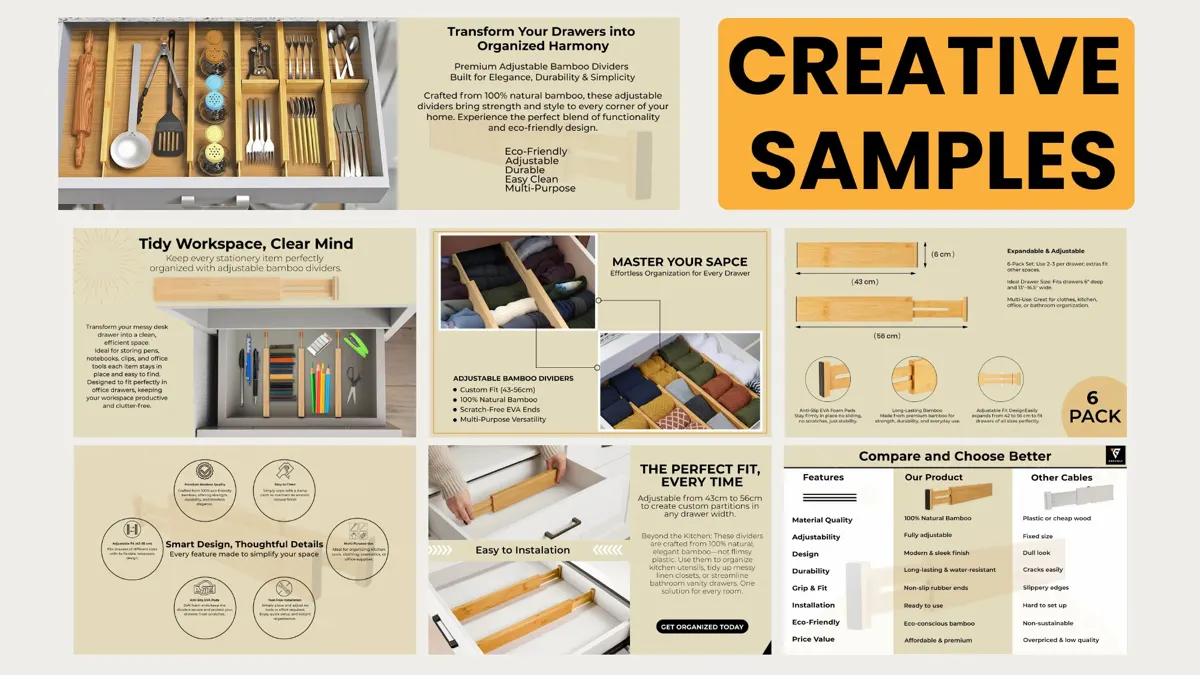
A+ Content and listing images
A+ Content adds images, comparison charts and brand story modules below your product description. Amazon says Basic A+ Content can increase sales by up to 8%, and Premium A+ Content by up to 20%, based on its own data. You need a Professional selling account and Brand Registry to use it.
I design A+ modules and listing images in Photoshop. Here are some of my samples:


Common Amazon PPC mistakes I fix
- Running only automatic campaigns for months without moving winners to manual campaigns
- No negative keywords, so the same useless search terms keep spending
- One bid for every keyword, whatever it earns
- Advertising products with few reviews or a weak main image
- Judging ads on ACOS alone and ignoring total sales and profit
- Changing everything at once, so nobody knows what worked
If your account has any of these, a short audit usually finds savings quickly. You can also see results from accounts I have managed on my Amazon seller account management page.
Keyword match types made simple
Amazon lets you choose how closely a shopper’s search must match your keyword. Using the right mix stops you paying for the wrong clicks.
| Match type | When your ad shows | Best use |
|---|---|---|
| Broad | Shows for searches that include your words in any order, plus related terms | Finding new keywords |
| Phrase | Shows for searches that contain your phrase in the same order | Balancing reach and control |
| Exact | Shows only for your exact term and close variants | Spending on proven sellers |
| Negative | Stops your ad showing for a term | Cutting waste |
A healthy account usually moves budget over time from broad and automatic campaigns towards exact match, as the data shows which terms actually sell.
The campaign structure I use
- Research campaign: automatic targeting with a modest budget, to find search terms you would not think of.
- Performance campaigns: exact match campaigns for your best keywords, with their own budgets so they never run out early.
- Brand defence: a small campaign on your own brand name, so competitors cannot take those shoppers cheaply.
- Product targeting: ads on competitor or related product pages where your offer compares well.
- Sponsored Brands: logo and headline ads for brand-registered sellers, to build recognition on top searches.
Keeping these separate makes reports clear. You can see what research costs, what your best keywords earn and what defending your brand protects.
Arabic keywords on Amazon.ae
Some shoppers on Amazon.ae search in Arabic, and Arabic keywords often cost less per click because fewer sellers target them. I check Arabic search terms in your reports and add the ones that convert to your listing’s backend terms and your campaigns.
The Amazon ad reports I read every week
- Search term report: the real words shoppers typed before clicking your ad. This is where I find new keywords and terms to block.
- Placement report: how your ads perform at the top of search, in the rest of search and on product pages, so I can set placement bids.
- Advertised product report: which products turn ad clicks into sales, and which ones need a better listing before more spend.
- Purchased product report: sales of other products from your brand after an ad click, which shows the wider value of a campaign.
- Business reports in Seller Central: sessions and conversion rate for each product, including sales that did not come from ads.
Reading these together shows whether a problem sits in the ads, the listing or the price. That stops the common mistake of cutting a campaign when the real issue is a weak main image or a price above competitors.
Price, coupons and deals work with your ads
Ads send shoppers to your product, but the buy decision happens on the page. Price is a big part of it. If your price is well above similar products with more reviews, even good ads will struggle.
I check your price against the top competitors for each main keyword. Where it makes sense, I suggest a coupon or a limited-time deal during launch or slow months. Coupons show a badge in search results, which can lift click-through rate on the same ad spend. After each promotion, I compare sales, ACOS and profit, so you know if it was worth repeating.
Amazon PPC and listing prices
Flat fees, not a percentage of your ad spend. Starting prices below; your ad budget is paid directly to Amazon.
Listing Optimization
AED 150
per product
- Keyword research
- Title and five bullet points
- Backend search terms
- Image recommendations
Most popular
Amazon PPC
From AED 1,000
per month
- Up to AED 10,000 monthly ad spend
- Weekly bid and keyword changes
- Negative keyword cleanup
- Monthly ACOS and TACOS report
A+ Content Design
AED 275
per product
- Basic A+ modules
- Comparison chart
- Brand story section
- Designed in Photoshop
Prices in AED, excluding VAT and ad spend. See all prices and packages.
Frequently asked questions
What is a good ACOS on Amazon UAE?
It depends on your margin. Work out your break-even ACOS by dividing your profit per unit before ads by your selling price. Many sellers aim below that number for steady sales and accept a higher ACOS during a launch.
How much should I spend on Amazon PPC?
Start with a budget you can keep for at least a month, so the campaigns gather enough data. I suggest a starting daily budget after looking at your prices, margins and competition.
How long until PPC results improve?
The first two to four weeks are mostly about collecting data. Most accounts see clearer results after one to three months of weekly changes.
Do I need Brand Registry for Amazon ads?
You can run Sponsored Products without Brand Registry on a Professional account. Sponsored Brands ads and A+ Content need Brand Registry.
Is A+ Content worth it?
For most branded products, yes. Amazon says Basic A+ Content can lift sales by up to 8%. It also helps shoppers understand your product, which can reduce returns.
Do you need my Seller Central password?
No. You add me as a user with the permissions I need for advertising and listings. You can remove my access at any time.
Want your ad spend to work harder?
Send me a screenshot of your campaign manager or your product link. I will reply on WhatsApp with what I would change first.
Related services
Sources
- Amazon Ads, Sponsored Products
- Amazon, A+ Content
- Amazon, Brand Registry requirements
- Amazon.ae, Selling fees and pricing
Last updated: November 2026